
Most audio enthusiasts recognize the signature sound of a high-end amplifier, but few realize that the clarity they hear is largely determined by the power source. In premium audio, the input signal is often in the range of mere millivolts—weak enough to be easily overwhelmed by electromagnetic noise. To preserve this signal, a silent, efficient, and stable power stage is mandatory.
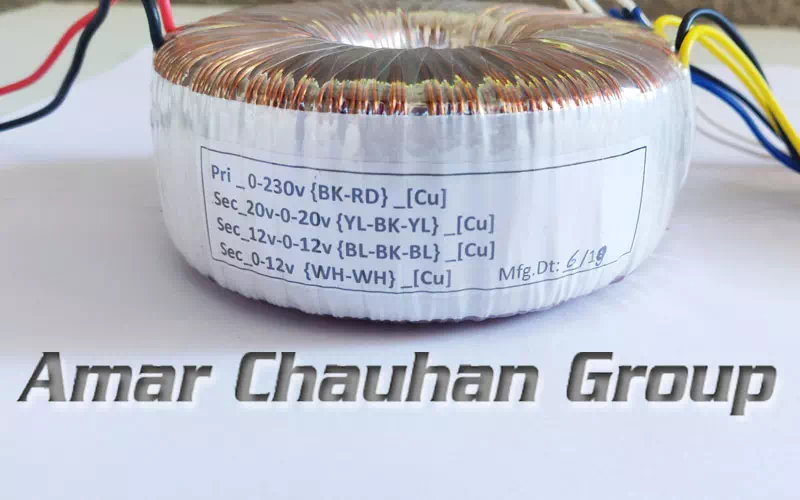 Standard 20-0-20 Toroidal setup for Class AB Amplifiers
1. Concentrated Fields, Lower Leakage Flux
In a standard transformer, magnetic lines of flux spread out at significant distances, often "cutting" through nearby signal wires. This induces unwanted voltage directly into your audio path, resulting in a poor Signal-to-Noise Ratio (SNR). Because a toroidal transformer is a continuous donut shape, the magnetic field is concentrated inside the core. Stray flux is typically 1/10th of a traditional EI transformer, ensuring your circuit boards "breathe" in a noise-free environment.
2. Eliminating Mechanical Hum
Physical vibration is the enemy of high-fidelity sound. Traditional transformers are made of stacked sheets that can loosen and vibrate at 50Hz, creating an audible mechanical "buzz" that persists even during quiet passages of music. The toroidal design is inherently self-dampening. Tightly wound copper around a solid, gapless core eliminates the loose finishes that cause vibration, providing the "black background" silence demanded by audiophiles.
The Engineer's Advantage
Using a toroid allows for better Signal-to-Noise ratios without needing excessive and heavy shielding on internal signal cables.
3. Thermal Efficiency and Stability
Modern amplifiers generate significant heat from switching transistors and MOSFETs. A traditional transformer adds massive heat to an already hot cabinet, accelerating the degradation of sensitive capacitors and components. Toroidal transformers operate with much higher efficiency, reducing internal heat generation by more than 50%. This lower operating temperature extends the life of the entire amplifier system.
4. Weight and Aesthetic Design
Progress in audio design has moved toward slimmer, more portable, and sleeker units. The governing factor in an amplifier's weight is almost always the transformer. A toroidal unit offers 50% less weight than an EI counterpart for the same power rating. This allows designers to use thinner chassis materials and achieve "slim-line" aesthetics without compromising on raw power delivery.
₹ Savings + Performance
High-purity copper windings ensure maximum conductivity and minimum resistance.
Final Thoughts
Aesthetics, weight, and thermal management are no longer optional "extras" in the audio market—they are requirements. As the industry moves toward GaN MOSFETs and high-efficiency designs, the toroidal transformer remains the only power source capable of keeping up with modern audio standards. At Vaani, we specialize in winding the "silent hearts" that power India's best sound systems.