
If your equipment has ever picked up a background hum, a random sensor glitch, or a microprocessor reset with no obvious cause, the culprit is often noise riding on the power line itself — high-frequency spikes thrown off by nearby motors, switching power supplies, or industrial equipment. A standard transformer doesn't stop this kind of noise; it can pass straight through and contaminate whatever's connected downstream. An Electrostatic Shield (ES Shield) — a grounded copper layer built into the transformer — is what closes that gap, and it's a detail worth understanding before you spec your next build.
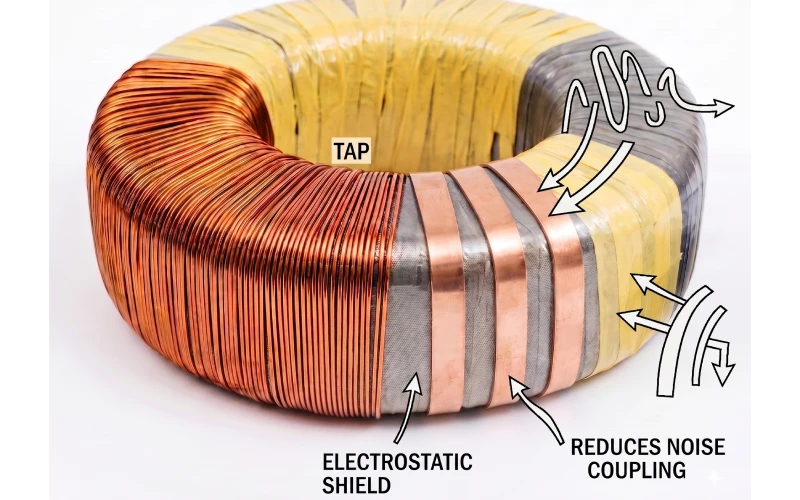 A toroidal transformer built with a grounded copper ES shield to block noise between windings
Two Paths Noise Can Take Through a Transformer
Power is only supposed to cross a transformer one way: through the magnetic field, from primary to secondary. But there's a second, unwanted path — high-frequency noise can jump straight across the small insulation gap between the windings through a natural effect called stray capacitance, skipping the magnetic field entirely. On a standard transformer, that second path is wide open, so any noise sitting on your incoming power line has a direct route into whatever the transformer is powering. An ES shield closes that second path by giving the noise somewhere safer to go — straight to ground — before it ever reaches your circuit.
Why This Matters to You
You're not paying for a copper strip — you're paying for what it stops. Noise that never reaches your secondary side is noise you don't have to filter, troubleshoot, or explain to a customer later.
1. Cleaner Power, Without Extra Filtering Hardware
Blocking noise at the transformer, before it ever spreads into the rest of your circuit, is far more effective than trying to filter it out afterward. An ES shield does exactly that — it stops high-frequency interference from crossing over in the first place, which means your downstream electronics see genuinely clean power. In practice, that often removes the need for extra external line filters or suppression components you'd otherwise have to design in, tune, and pay for separately.
2. An Extra Layer of Safety for Equipment and People
Beyond routine noise, the shield also acts as a safety backstop. In the rare event of a serious insulation fault or a high-voltage surge on the primary side, the grounded copper layer gives that dangerous voltage a direct, low-resistance path to ground — instead of a path into your secondary circuit and whatever's connected to it. That's protection for both the electronics downstream and anyone operating the equipment, on top of the everyday noise filtering.
3. Lower Leakage Current for Sensitive, Regulated Applications
Reducing the capacitive coupling between windings doesn't just cut noise — it also lowers stray leakage current flowing to ground. That matters a great deal in fields where leakage current is tightly regulated for patient and operator safety, like medical devices and precision lab instruments. Choosing an ES-shielded transformer makes it meaningfully easier to meet those strict leakage limits without extra downstream circuitry to compensate.
Put together, here's what an ES-shielded transformer is actually doing for your product:
Where an ES Shield Is Worth Specifying
A standard transformer works fine for general utility loads that don't care about noise. But once clean signal, low leakage, or reliable operation near noisy equipment actually matters to your product, an ES shield stops being optional:
Final Thoughts
An electrostatic shield is a small, inexpensive addition next to the difference it makes — quieter power, a real safety backstop, and lower leakage current, all from a single grounded copper layer inside the transformer. At Vaani, we build custom toroidal transformers on CRGO silicon steel cores with 100% electrolytic copper windings, and can add a copper ES shield engineered to your exact noise-suppression and safety requirements.