
Every transformer is built to run warm — but on a bad day, an overload, a voltage spike, or a fan that's stopped working can push winding temperatures past what's safe. What happens next is what actually decides whether that's a minor blip or a service headache. Most transformers still rely on a standard one-time thermal fuse: the moment it trips, the circuit is dead for good, and your product stays dead until someone opens it up and replaces the part. A resettable thermal fuse built into a custom toroidal transformer changes that outcome completely — it protects your product the same way, but brings the power back on by itself once things cool down.
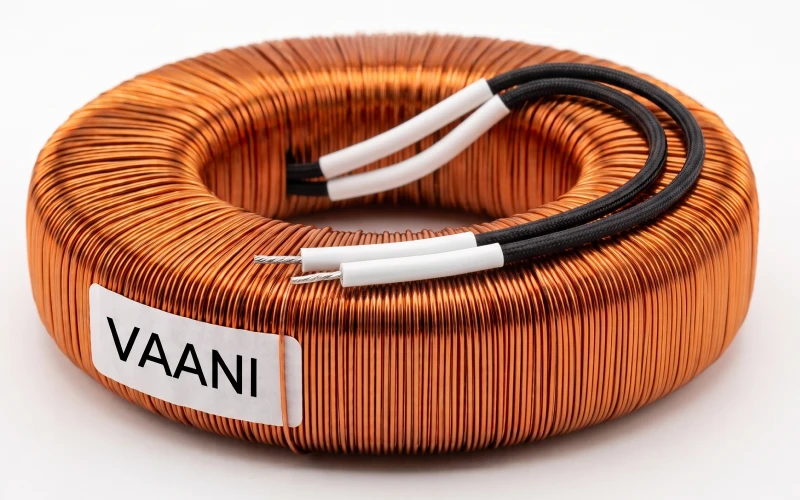 A custom toroidal transformer with built-in resettable thermal protection
1. No More Truck Rolls: Power Comes Back On By Itself
When a standard thermal fuse blows, that's the end of the story — it's a one-way, "sacrificial" component, and there's usually no practical way to reach it once it's sealed under insulation tape or resin. For you, that means a dead unit, a service call or return, and a wait until someone physically replaces the transformer. A resettable thermal fuse never puts you in that position: once the winding cools back down to a safe temperature, the switch closes again on its own and power is restored automatically — no technician, no replacement part, no product sitting idle waiting on a repair.
The Bottom Line
An overload becomes a brief pause instead of a support ticket. Your product protects itself and comes back online without anyone having to do anything.
2. Protection That Reacts Before Damage Happens, Not After
The thermal switch sits right where the heat actually builds up, so it's tracking real winding temperature rather than guessing from the outside. That means it catches a developing overload — a stuck fan, a jammed motor, a sustained overcurrent — early enough to cut power before insulation starts breaking down, and well before a short circuit or a burnt winding becomes a fire risk. You get protection that acts on the actual condition of the transformer in real time, not a fixed current rating that can miss a slow, sustained heat buildup.
3. A Transformer That Simply Lasts Longer
Heat is the single biggest reason winding insulation ages and eventually fails — as a rule of thumb, every 10°C a winding runs above its insulation class rating roughly halves the remaining life of that insulation. A resettable thermal fuse is set to trip right at that threshold (commonly around 105°C for Class B or 130°C for Class F insulation), so the winding is never allowed to sit in that damaging heat for long. Every time it trips and resets, it's quietly protecting the years of service life you're paying for — instead of letting a single hot afternoon shorten the whole product's lifespan.
4. You Get the Protection Without Losing the Toroidal Advantage
None of this comes at the cost of the compact, low-profile form factor that's the whole reason you chose a toroidal transformer in the first place. The thermal protector sits flat against the core, adds no measurable height or diameter to the finished unit, and is fully sealed against moisture, varnish, and mounting pressure once assembly is complete. You get automatic thermal protection built in from day one, in a transformer that still fits the same footprint your enclosure was designed around.
What Actually Happens Inside Your Product When It Overheats
From the outside, the whole cycle is invisible to your end user — no reset button to press, no fuse to source and replace. Here's the sequence that plays out automatically:
The reset isn't instant, and that's by design — a hysteresis gap of roughly 15–30°C between the trip point and the reset point stops the fuse from chattering on and off while the winding is still borderline hot. Power only comes back once the transformer has genuinely cooled to a safe operating temperature, so you're never left with a protection cycle that trips repeatedly without actually solving the underlying heat problem.
This kind of built-in, self-recovering protection pays off most in products where downtime is expensive or a service visit is impractical:
Final Thoughts
The value of a resettable thermal fuse isn't that it protects your product — a basic thermal fuse does that too. It's that it protects your product and keeps it running, cycle after cycle, without turning every overload into a return or a repair ticket. At Vaani, we build custom toroidal transformers on CRGO silicon steel cores with 100% electrolytic copper windings, and can fit a resettable thermal fuse calibrated to your exact Class B or Class F insulation rating — so your product gets automatic, ongoing protection instead of a one-shot safety net.