
If a transformer has ever developed a faint buzz over time, or failed early after sitting in a damp or dusty enclosure, the root cause is usually the same: microscopic air gaps trapped inside the winding. Those gaps let heat build up, let moisture creep in, and let copper turns vibrate against each other — and none of that shows up on a datasheet until it's already a problem. Vacuum Varnish Impregnation (VPI) is what closes that gap for good, and it's the reason a properly treated toroidal transformer stays quiet, cool, and sealed for the long haul.
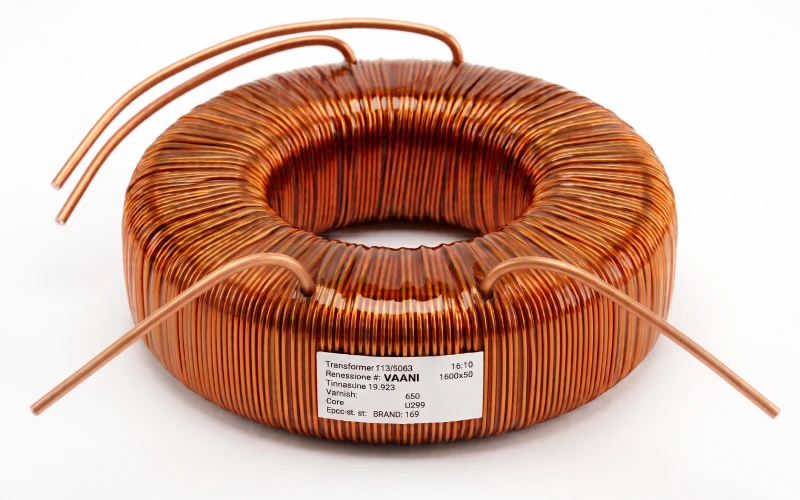 A vacuum-impregnated toroidal transformer — sealed as one solid block, not just dipped on the surface
What Is VPI, in Plain Terms?
Ordinary varnish dipping only coats the outside of a coil — underneath that surface, tiny air pockets are still trapped between the wire strands. Vacuum impregnation goes further: the transformer is placed under vacuum to pull that trapped air out, then high-grade insulating varnish is drawn in and cured solid, so every internal gap gets filled rather than just the outer shell. The result is a winding that behaves like one solid, sealed block instead of a bundle of wire with air pockets hiding inside it.
Why This Matters to You
You're not buying a varnish process — you're buying what it prevents: hum that gets worse with age, hotspots you can't see forming, and moisture damage that shows up months after installation. VPI removes the weak point before it ever becomes your problem.
1. Whisper-Quiet Operation, Even After Years of Use
Every transformer's copper turns experience a tiny magnetic pull at mains frequency — in a standard unit, with air gaps left between the wires, that pull lets individual turns vibrate slightly against each other, and that's the buzz you hear that tends to get louder over time. Once the winding is fused into one solid mass by VPI, there's nothing left loose to vibrate. For audio amplifiers, recording studios, and medical devices where any audible hum is unacceptable, this is the single biggest reason to specify a VPI-treated transformer.
2. Runs Cooler, Which Means It Lasts Longer
Trapped air is a poor conductor of heat, so any air pocket left inside a winding acts like a tiny thermal blanket — quietly holding heat right where it does the most damage to insulation. Solid varnish conducts heat far better than air, so once the gaps are filled, heat generated deep in the winding can actually reach the outer surface and dissipate instead of building up into a hidden hotspot. A cooler-running transformer is a longer-lived one — heat is the single biggest driver of insulation aging, so removing hidden hotspots is one of the most effective things you can do for service life.
3. Sealed Against Moisture, Dust, and Corrosive Fumes
Outdoor installations, solar inverters, and industrial floors all expose a transformer to humidity, airborne dust, oil mist, or corrosive fumes over time. A dip-coated winding only protects against this on the outer layer — moisture can still work its way in along the same paths the air pockets left open. A VPI-treated core is effectively sealed from the inside, so there's no internal path left for moisture or contaminants to reach the copper and start corroding it. That's a real difference in how long the transformer keeps performing once it's out of a climate-controlled room.
4. A Wider Safety Margin Against Electrical Breakdown
Air is a comparatively weak insulator next to cured varnish. Every trapped air pocket between the primary and secondary windings is a slightly weaker point where high voltage stress could eventually break down the insulation. Filling those gaps with solid, high-dielectric varnish pushes that breakdown threshold much higher, giving you a wider safety margin and a transformer that holds up better over years of voltage stress — not just on the day it leaves the factory.
Put together, here's what choosing a VPI-treated transformer actually gets you:
Where This Upgrade Is Worth Insisting On
Basic surface coating can be enough for low-cost, low-stakes electronics. But once hum, heat, or environmental exposure could actually affect how well your product works — or how long it lasts — VPI stops being optional:
Final Thoughts
VPI doesn't change what a transformer does — it changes how reliably it keeps doing it, year after year, in whatever environment it ends up living in. At Vaani, every custom toroidal transformer we build on CRGO silicon steel cores with 100% electrolytic copper windings goes through full vacuum-pressure impregnation as standard, so you get whisper-quiet operation, better thermal performance, and a transformer that's sealed against the environment from day one.